Transition to deployment phase approaching: update on project status
Impressive progress has been made across the entire collaboration, with production progress vital as we continue to progress towards deployment in the LHC tunnel. The upcoming Collaboration Meeting will be an exciting time to meet just after the start of deinstallation of the machine, to reflect on what we have achieved so far and what is ahead of us.
The High-Luminosity (HiLumi) LHC Project has made impressive progress since the last annual meeting held at CERN in September 2025 and is now a little less than a month away from the transition into the deployment phase in the LHC tunnel, when the present third run of the LHC will come to a successful end on 29th June. This moment represents a major milestone for the collaboration, marking the shift from production, testing, and validation activities into full-scale installation and integration in the LHC tunnel during the four year-long Long Shutdown 3 (LS3).
Particular highlights over this past year include the successful repair and redesign of key technical systems following the discovery of leaks in the Line N busbar system of the IT String. The non-conformities were successfully repaired and mitigated by the end 2025, and the IT String could be subsequently cooled down early this year. The findings from this incident have led to a complete redesign of the busbar system, which has been incorporated into the new HiLumi LHC installation baseline in the LHC tunnel. Commissioning and powering tests have already started, beginning at the end of April, providing valuable operational experience and a series of important lessons learned during this first integrated operational period of the complete inner triplet system.
Another important milestone has been achieved with the second field test for the vertical cores, which enabled the construction of a 6-metre-long core excavated from UA17 in the HiLumi galleries. This successful demonstration validated the final excavation methodologies as well as the associated logistics and coordination processes. It has significantly strengthened confidence in the tight scheduling constraints associated with this activity within the LS3 baseline schedule, confirming both feasibility and execution readiness.
With LS3 approaching rapidly, it is essential to continue taking stock of production progress across all major components of the project.
A key milestone in this regard has been reached with half of the AUP cryo-assemblies delivered to CERN by the end of last year, and two further units expected to arrive before the summer. At CERN, quadrupole production is now reaching completion, allowing resources and expertise to be progressively reallocated in preparation for the start of de-installation works in the LHC tunnel this autumn.
KEK has successfully delivered their third cold mass to CERN, with two additional magnets successfully validated at cold in vertical configuration. Cold mass assembly of the remaining three units is progressing, following the successful signature of the contracts for the spare units with the industrial supplier. The DQHDS production is advancing very well and is approaching completion, including the units required for the consolidation of the standalone quadrupole and dipole magnets of the LHC.
From our INFN collaborators, the third magnet has been very successfully tested to ultimate current in SM18, while the final three units still require rework at the supplier’s premises after suffering repeated electrical issues. Both the Chinese and Spanish collaborations have successfully completed their last magnet deliverables and are now coming to a successful close, with the final spare coils expected to be delivered to CERN around the summer period.
On the crab cavity side, significant progress has also been achieved. The assembly of the first DQW cryomodule by our UK colleagues has been completed and is due to arrive at CERN in the coming weeks. A first dressed RFD cavity, which successfully passed prior cold tests at JLAB, has arrived at TRIUMF, where colleagues are preparing to begin assembly of the first cryomodule as soon as the second dressed cavity becomes available.
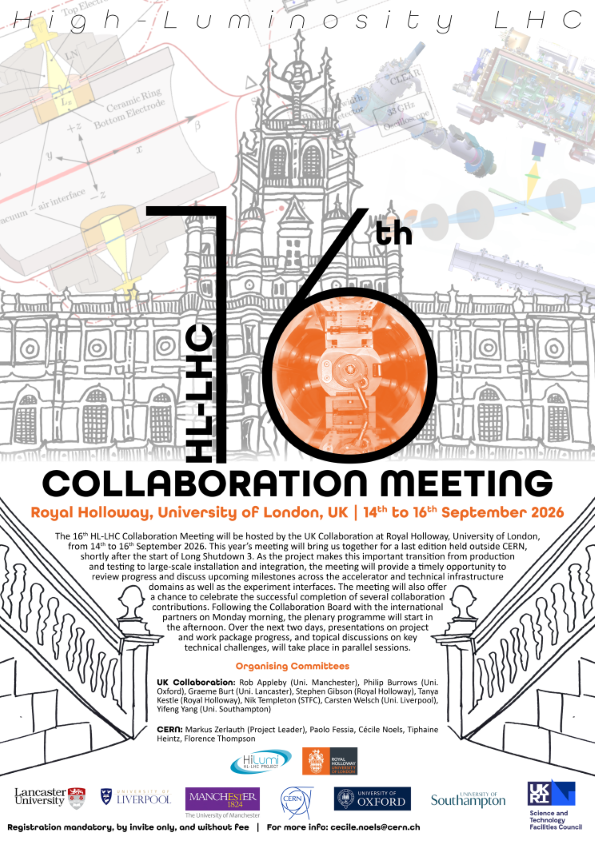
At this particularly exciting moment of the project, the Collaboration Meeting will return in early September to the United Kingdom for a second time, thirteen years after the meeting held at Daresbury Laboratory in 2013. This year’s 16th edition will be hosted by our British partners at Royal Holloway and will bring together all members of the collaboration and partner institutions shortly after the start of Long Shutdown 3 (LS3). As the project makes this important transition to the final installation stage, the meeting will provide a timely opportunity to review progress and discuss upcoming milestones across the accelerator and technical infrastructure domains, as well as the interfaces towards the experiments.
Along with the entire project team at CERN we are much looking forward to meeting you there to take stock of all the great achievements across our collaborations!