LHC High-Intensity Tests paving the way for HiLumi LHC
During the two days dedicated to LHC high-intensity tests, the accelerator successfully operated with an unprecedented number of high-intensity bunches and provided encouraging results and valuable lessons ahead of the main high-intensity test campaign planned in late-June.
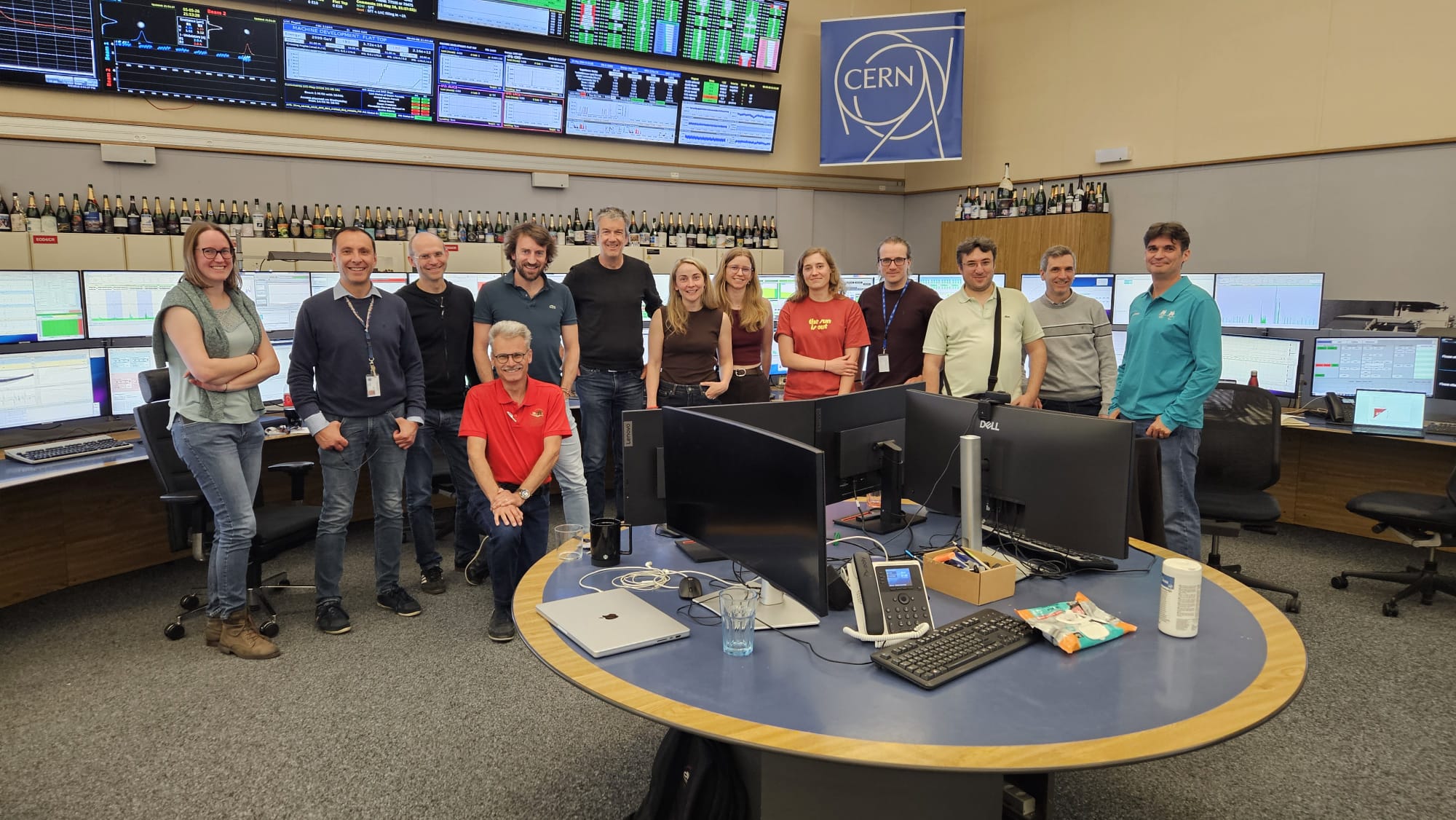
Preparatory tests for the LHC high-intensity (HI) period, carried out on 4th to 6th May 2026 marked an important milestone in the preparation for High-Luminosity LHC (HiLumi LHC) operation. During the two days dedicated to these tests, the accelerator successfully operated with an unprecedented number of high-intensity bunches – almost doubling the number reached in 2025. The tests provided both encouraging results and valuable lessons ahead of the main high-intensity test campaign planned for the second half of June.
Encouraging results
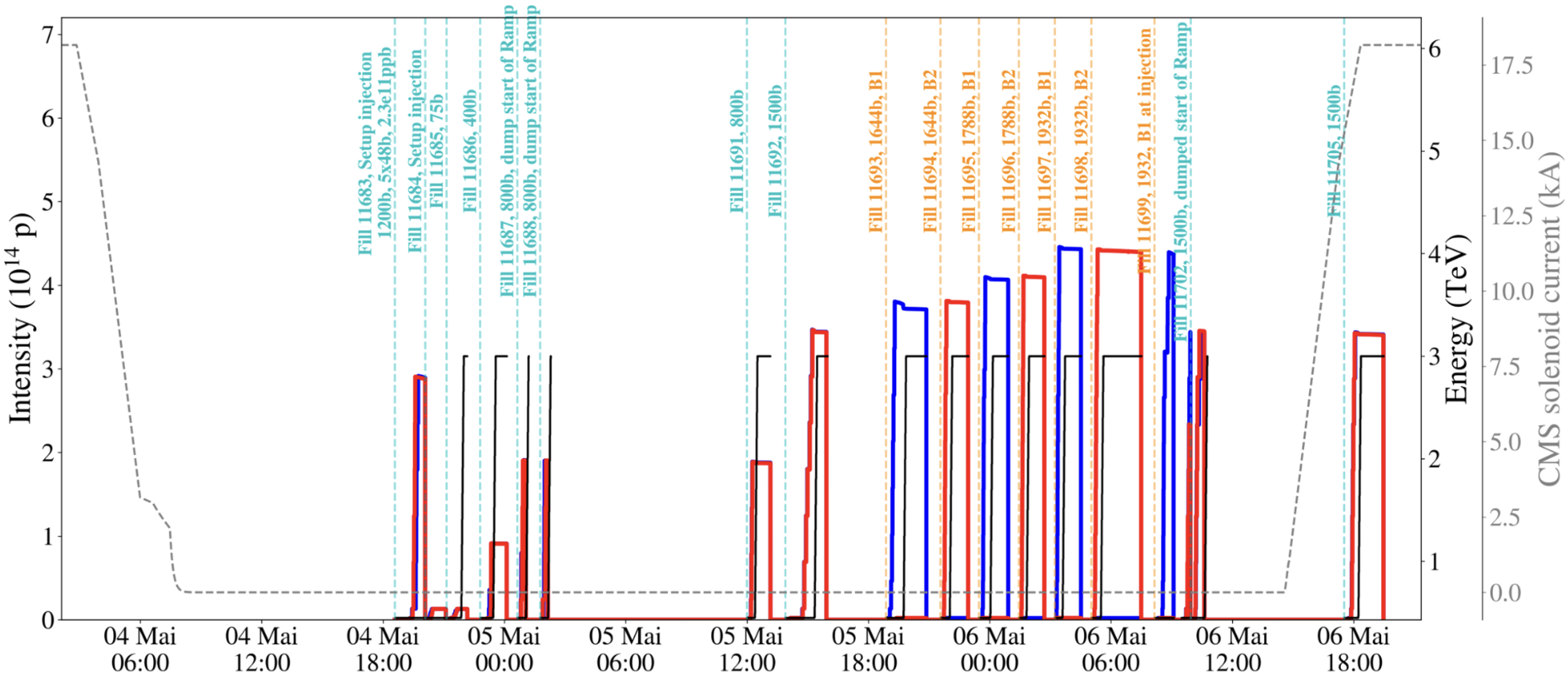
Among the most notable achievements was the first successful ramp to 3 TeV of 1500 bunches in both beams, using high-brightness Batch Compression Merging and Splitting (BCMS) beams in a 5×48 bunch-train configuration. In addition, for the first time, close to 2000 bunches in a single beam were ramped to 3 TeV (see figure 2). This significantly extended the operational envelope in terms of beam-induced power in most devices installed on the present LHC beam line, although still well below that of the HiLumi baseline of 2760 bunches.
The tests also demonstrated excellent beam quality from the injectors, with high bunch intensities of around 2.3×10¹¹ protons per bunch and low transverse emittances. Bunch-length control during the ramp and at flat top was particularly successful, with measurements in excellent agreement with the state-of-the-art model based on intra-beam scattering and synchrotron radiation.
For the capture of SPS bunch trains, a novel technique using phase-modulated RF buckets was tested, and significantly reduced the RF power, paving the way for increased RF capture voltage in the HiLumi LHC era.
Additionally, a machine development (MD) study performed before the HI tests managed to probe longitudinal coupled-bunch instabilities when a narrow-band impedance is present, providing crucial data for future operation with crab cavities.
Finally, the HI tests were performed with the CMS solenoid off, which proved not to be an issue in terms of e-cloud generation; this configuration (or a similar one with a small solenoid field) can therefore be used for the main HI tests in June.
Lessons learnt
At the same time, the tests highlighted several important challenges. Firstly, several dumps occurred at the start of the ramp, and these were due to off-momentum losses, ultimately understood and mitigated. The campaign also revealed episodes of close-to-broken collimation hierarchy during the ramp, which will have to be understood and addressed before the June tests.
Vacuum activity was observed in several locations in various parts of the ring, which may suggest possible beam-induced heating or outgassing effects at such intensity levels. On the other hand, hints of RF conditioning were observed, and the vacuum activity never reached alarming levels. Physics operation could therefore resume normally without any issue after the tests.
Such vacuum activity is not limiting at this stage and will be followed-up during the June tests; they are precisely the type of effects the 2026 high-intensity program aims to clarify, to allow the definition and implementation of possible mitigations during Long Shutdown 3 in case intensity limitations appear.
Looking towards the next HI test campaign
The forthcoming two-week high-intensity campaign at the end of June 2026 will therefore represent a critical next step. The strategy combines tests at 3 TeV and 6.8 TeV with several beam configurations, including the HiLumi LHC 4×72 baseline scheme, gradually pushing beyond present operational limits while carefully monitoring impedance-related heating, electron-cloud effects, beam lifetime, and halo behaviour. The ultimate objective is either to conclusively validate HiLumi LHC beam conditions or to identify the remaining limiting devices before Run 4 begins in 2030.
In parallel: beam dynamics studies
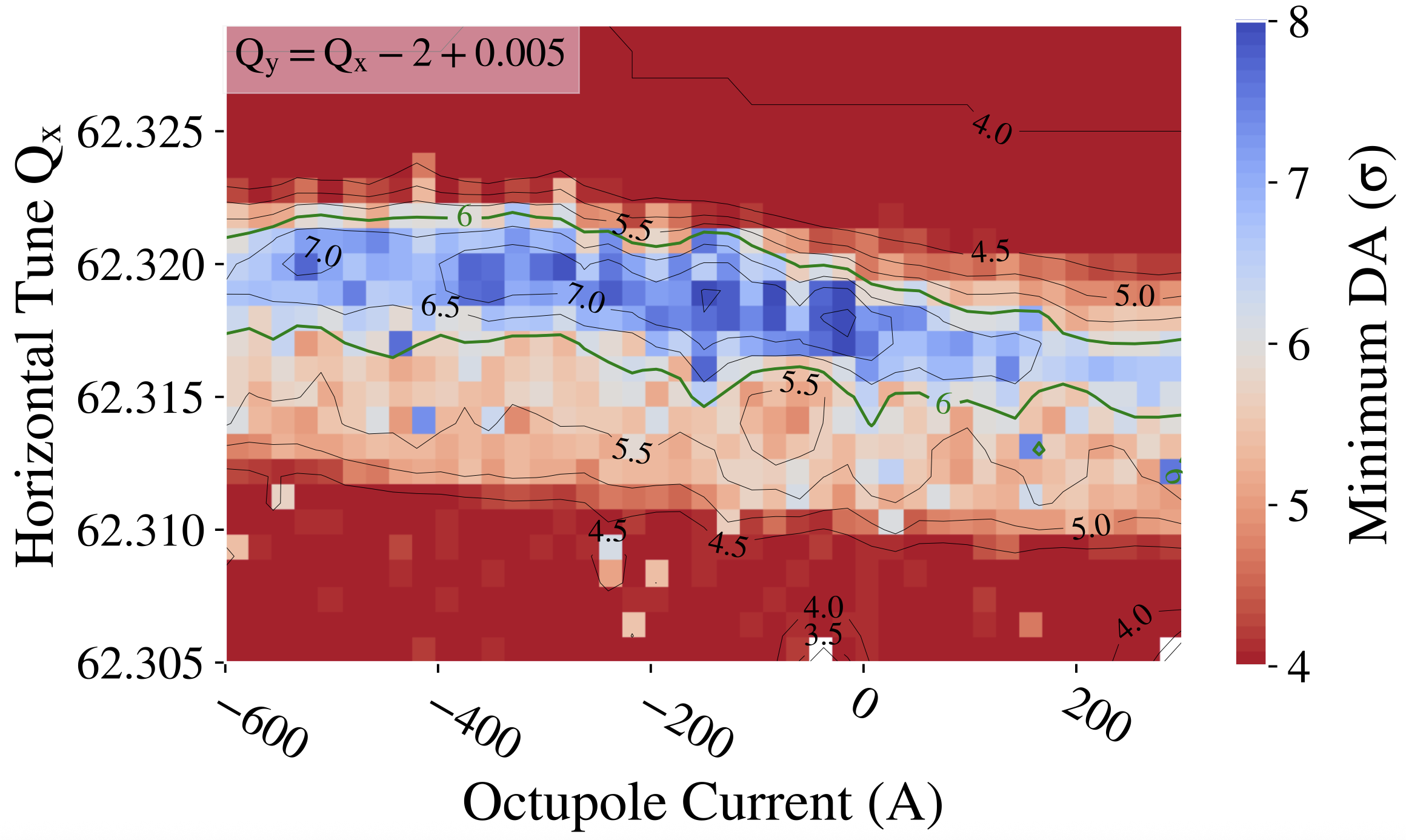
In parallel, recent beam dynamics studies continue to strengthen confidence in the HiLumi LHC operational baseline. Updated dynamic-aperture simulations show particularly encouraging results at end of collapse with negative octupole polarity, which is now a strong candidate to become the baseline choice for operation. Even for large octupole currents, the available dynamic aperture remains comfortable, providing an additional operational margin for stability and impedance mitigation schemes foreseen for HiLumi LHC (see figure 3). Investigations are now ongoing to verify the impact of this polarity on other aspects of the machine, such as the collimation system.