
Cold Powering System transitions into preparation stages for installation following completion of collaboration deliverables
Following the steady progress of productions of the Cold Powering Systems, including the completion of deliverables from SOTON and Uppsala University, preparations are well underway for installation in the underground.
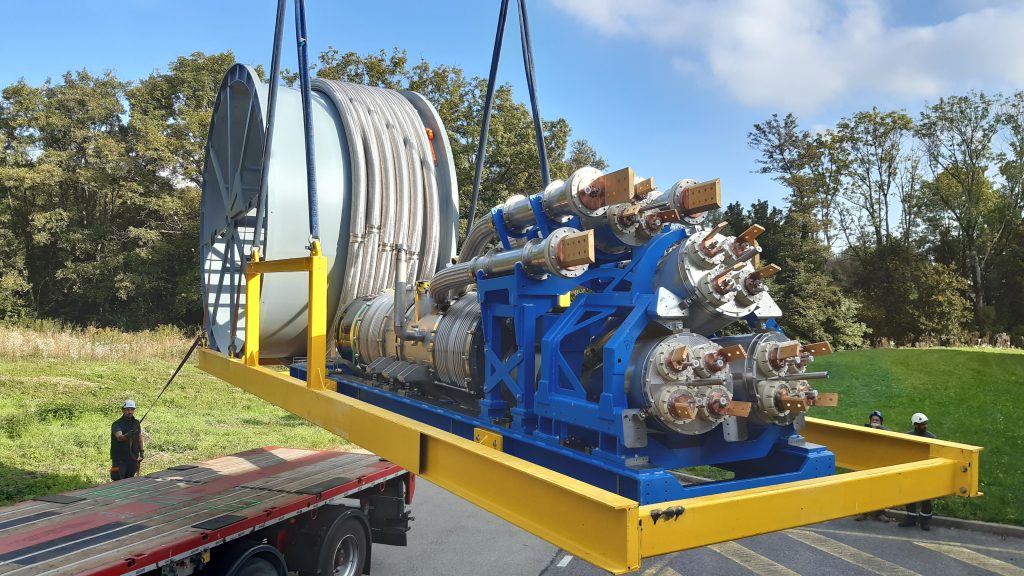
Activities for the powering of the HiLumi magnets (Work Package 6A) in 2026 are focused on the assembly and testing of the series Cold Powering Systems at CERN, as well as on preparations for their installation in the High-Luminosity (HiLumi) LHC and LHC underground areas.
All external procurement was completed by the end of 2025, including four major industrial contracts (MgB₂ wire, REBCO tape, MgB₂ cabling, and Superconducting Link cryostats) and two collaboration agreements.
The collaboration agreement with Uppsala University was successfully concluded in 2024 with the delivery of all DFHX and DFHM cryostat components, five of each type (link). The collaboration agreement with the University of Southampton (SOTON) was completed by the end of 2025 with the successful production of the ten DFX and DFM cryostats (link). The performance of these cryostats, which constitute key and complex subsystems of the cold powering systems, was confirmed during systems qualification at CERN.
At the time of writing, three Cold Powering Systems for the Triplets have been successfully qualified at their maximum operating current (approximately 100 kA), and one of them is currently operational in the IT String. A fourth system has been assembled and is ready for final testing, while the first cold powering system for the Matching Sections is in its final stages of completion.
A key outcome of this work is the demonstration of the reproducible performance of these complex systems, in terms of both assembly and operational behaviour under cryogenic, electrical, and mechanical conditions.
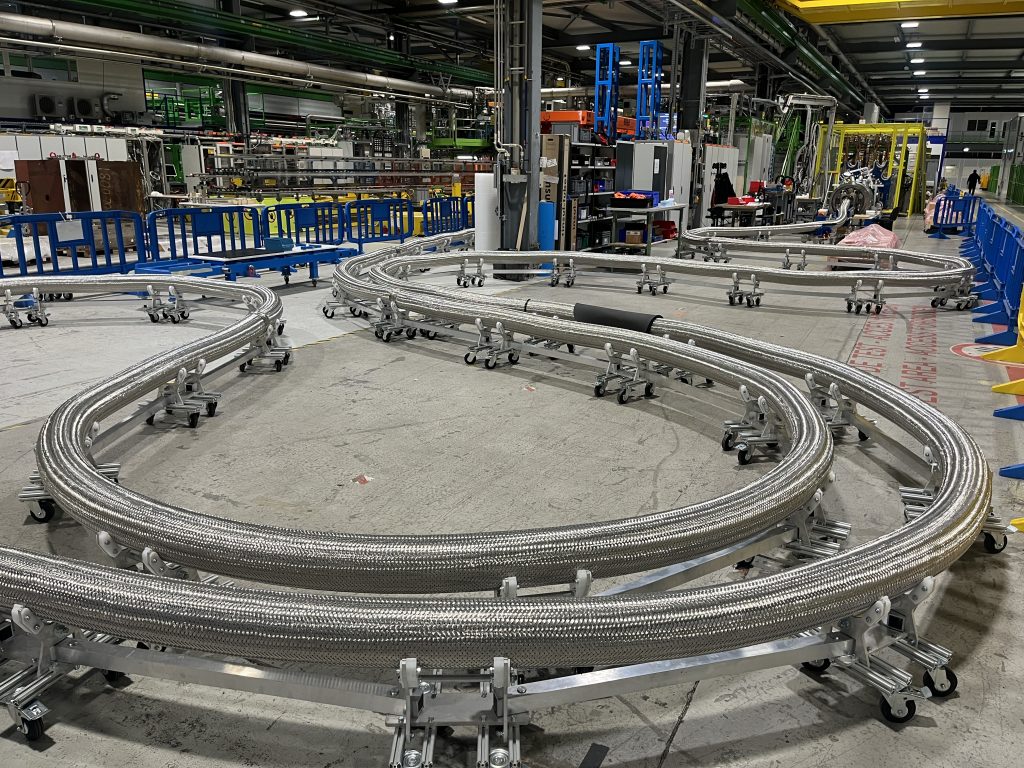
Series production at CERN of the locally installed conduction-cooled current leads for the Inner Triplet corrector circuits (≤ 200 A) has also been completed. In addition, qualification of the corrector magnets in dedicated test benches and in the IT String has confirmed the performance of these current leads under nominal operating conditions.
Important lessons have been learned from the spooling and transport operations of the Cold Powering Systems carried out at the surface. The experience gained to date has demonstrated the capability to handle and transport these complex systems in all required configurations.
In parallel, significant progress has been achieved in the design of the components and equipment needed for the transport and installation of the systems in the accelerator underground areas. Several validation tests have been performed, including a test in the HiLumi galleries to verify the installation procedure in the UR areas. The design of supporting structures, the development of remote axial handling systems, and associated surface tests are all ongoing to validate the integration procedure for the Superconducting Links in the HiLumi LHC vertical cores.
The progress achieved so far provides substantial confidence in the feasibility of the proposed transport and installation approach, while experience gained so far with the installation and operation of the Cold Powering System in the IT String has been fully positive.
Video explaining the Cold Powering System of HiLumi LHC to the general public. Copyright CERN